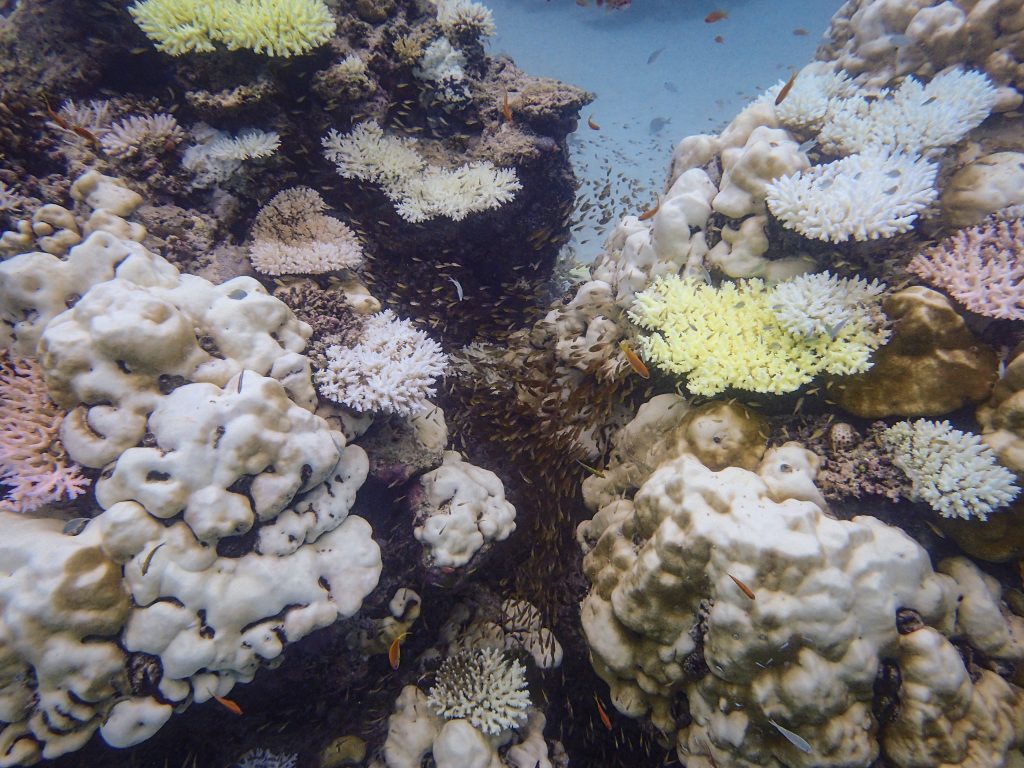
Press statement: Immediate measures needed to protect Maldives’ coral reefs from bleaching risk
13 April 2026: As of 11 April 2026, NOAA Coral Reef Watch has placed the Maldives under a Coral Bleaching Alert Level: Watch, indicating potential bleaching with low likelihood. However, forecasts indicate a significant escalation in the Maldives region within the next 1–12 weeks expected to reach Alert Level 1, where significant bleaching is likely.
Corals bleach when sea surface temperatures (SST) remain elevated for several weeks. Under heat stress, corals release the microscopic algae (zooxanthellae) that live within their tissues. These algae provide corals with their color and more than 90% of their energy.
As a result, during mass bleaching events, corals turn white. If temperatures return to normal quickly enough, corals can recover and regain their algae and color. However, if elevated temperatures persist, many corals may die, leading to mass mortality. The Maldives has already experienced severe impacts during the global bleaching events of 1998, 2016, and 2023.
In light of this projected heightened risk, we urge immediate precautionary action from all sectors:
- We call on the Government of Maldives to cease all dredging and land reclamation activities until conditions return to Normal. Dredging and reclamation increase sedimentation and turbidity, compounding thermal stress on corals at a time when they are most vulnerable. This suspension should be maintained for at least two weeks after alert levels return to “Normal”, if no reef stress is observed. However, if reef stress is observed, the suspension must be extended to four weeks post-recovery.
- We call on all tourism operators to suspend sand pumping and beach replenishment activities for the duration of the bleaching risk period. The tourism industry depends directly on healthy coral reefs, and taking precautionary measures now is crucial to safeguard our national assets.
- The Government, relevant institutions and tourism operators must also ensure all sewage is adequately treated before discharge to prevent nutrient pollution, which can further weaken reef resilience.
- We urge the public to exercise extra care when using reef areas. This includes avoiding anchor damage by using mooring buoys where available or anchoring away from reefs and minimizing physical damage from fishing and recreational activities. We also request those who observe coral bleaching in the Maldives to report it to Maldives Marine Research Institute using https://www.coraldatabase.gov.mv/reporting.
With another bleaching risk now on the horizon, every action that reduces local stress on reefs can improve their chances of survival. We urge all stakeholders to act swiftly and responsibly to protect the Maldives’ coral reefs during this critical period.
References:
https://coralreefwatch.noaa.gov/product/vs/gauges/maldives.php